
Broward County: $19.4M Rail Safety Rev, Future Trends
Broward County gets $19.4M grant for enhanced rail safety along Brightline corridor, improving 21 grade crossings.
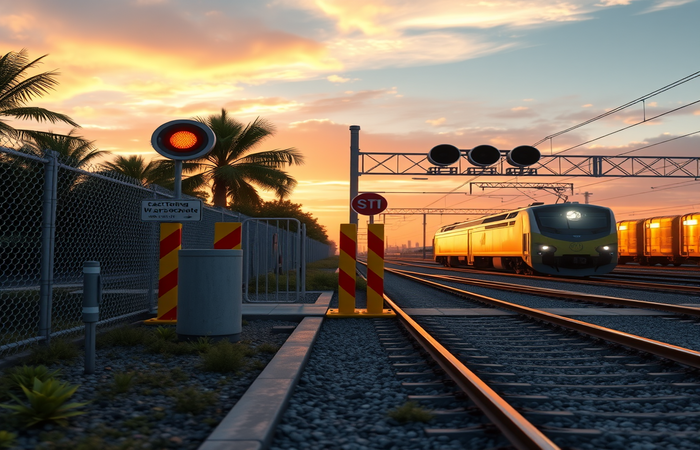
Broward County Secures $19.4 Million Investment for Enhanced Rail Safety
The Federal Railroad Administration (FRA) has awarded a $15.4 million grant to improve grade crossing safety along the Florida East Coast Railway (FECR) and Brightline rail corridor within Broward County, Florida. This significant investment, coupled with $3.9 million in matching funds from Broward County and six municipalities – Hallandale Beach, Hollywood, Dania Beach, Fort Lauderdale, Wilton Manors, and Pompano Beach – totals $19.4 million for the “Broward County Sealed Corridor Project.” This initiative, announced recently by Brightline, aims to bolster safety measures at 21 critical grade crossings and advance the creation of a “sealed corridor,” preventing unauthorized access and minimizing the risk of collisions. This article will delve into the specifics of the project, exploring its objectives, the technologies employed, and the broader implications for rail safety in the region.
Targeted Safety Enhancements
The core objective of the Broward County Sealed Corridor Project is to significantly enhance safety at 21 at-grade crossings. The project encompasses the design and construction of supplemental safety features, primarily focusing on the installation of exit gates and/or medians. These measures are designed to deter drivers from circumventing lowered crossing gates, a major contributor to accidents. The implementation of these physical barriers will effectively channel vehicular traffic, reducing the likelihood of drivers weaving around active warnings and entering the rail corridor unsafely. By establishing a clearly defined and secure perimeter, the project aims to minimize potential points of contact between vehicles and trains, ultimately enhancing safety for both motorists and rail passengers.
Technological Implementation: Gate Systems and Medians
The deployment of sophisticated crossing gate systems and the strategic placement of medians are the cornerstones of this safety initiative. The exact specifications for the gate systems will likely incorporate features such as flashing lights, audible warning devices, and potentially even infrared sensors to detect vehicles attempting to bypass the gates. Medians will be constructed at select crossings to further channel traffic, physically preventing vehicles from driving around the gates. The selection of locations for these installations will be based on factors such as traffic volume, accident history, and geometric characteristics of the crossing. Additionally, the project will likely integrate advanced control systems to synchronize the operation of gates, signals, and other safety devices, ensuring seamless and reliable performance.
Sealed Corridor Strategy: A Proactive Approach to Safety
The concept of a “sealed corridor” is central to the project’s design. This involves creating a protected zone along the rail line, minimizing the points of potential intrusion by vehicles or pedestrians. By detailedly addressing vulnerabilities at grade crossings, the project contributes to this broader strategy. This is essential for ensuring the operational efficiency and safety of high-speed rail, such as Brightline, and is increasingly recognized as best practice in modern railway operations. The sealed corridor approach not only enhances safety but also minimizes delays caused by unauthorized access or incidents, resulting in improved service reliability for passengers and freight operators alike.
Funding and Project Timeline
The $19.4 million investment represents a significant commitment to enhancing rail safety within Broward County. The funding comes from a combination of federal grants and local matching funds, demonstrating a collaborative effort between government agencies and municipalities. While specific timelines for the project’s completion have not been explicitly detailed in the release, the design and construction phases are likely to span several months, potentially involving phased implementations at the 21 crossings. The project’s successful execution will rely on effective coordination between the FRA, Brightline, FECR, and the participating cities. Regular updates and public outreach initiatives will likely be vital to keep the community informed and ensure minimal disruption during the construction phase.
Conclusion
The Broward County Sealed Corridor Project represents a significant stride in railway safety enhancements. By leveraging a combination of advanced technology, strategic infrastructure improvements, and collaborative funding efforts, the initiative addresses critical vulnerabilities at grade crossings along the Brightline and FECR corridors. This project, with its emphasis on exit gates and medians, highlights a forward-thinking strategy towards creating a safe railway environment. The positive impact of the “sealed corridor” approach will likely be felt across the region, leading to a reduction in accidents, fewer traffic delays, and improved overall safety for the traveling public and railway employees. Future investment into this form of infrastructure will undoubtedly lead to stronger and safer railway transportation systems across the country, benefiting communities by reducing accidents and enhancing the reliability of rail services. Further research in automated gate technologies, and predictive safety measures can be expected.

Railway infrastructure, rolling stock and transport technologies specialist focused on global rail industry developments, high-speed rail systems, signaling technologies and freight transportation. Covering railway investments, public transport modernization, rail operations and international mobility projects across Europe, Asia and North America.
RELATED POSTS

October 8, 2026 1:15 pm
Alstom secured a €1bn contract to build 13 automated trains,...

October 1, 2026 7:09 am
United States regulators confirmed a September 30 deadline for the...

October 4, 2026 5:14 pm
Alstom secured a CA$4.7 billion order from VIA Rail Canada...

October 5, 2026 6:12 pm
AECOM and Jacobs secured a contract in September 2026 to...

October 1, 2026 12:13 am
Illinois approved $1.5 billion annually for the Northern Illinois Transit...

October 4, 2026 11:08 pm
Sound Transit confirmed the September 30 opening of Seattle Pinehurst...