
Brenner Base Tunnel: PORR’s €966M Rail Innovation
The Brenner Base Tunnel’s €966 million contract pushes high-speed rail innovation. Discover how cutting-edge TBM technology tackles challenging geology on this monumental project!
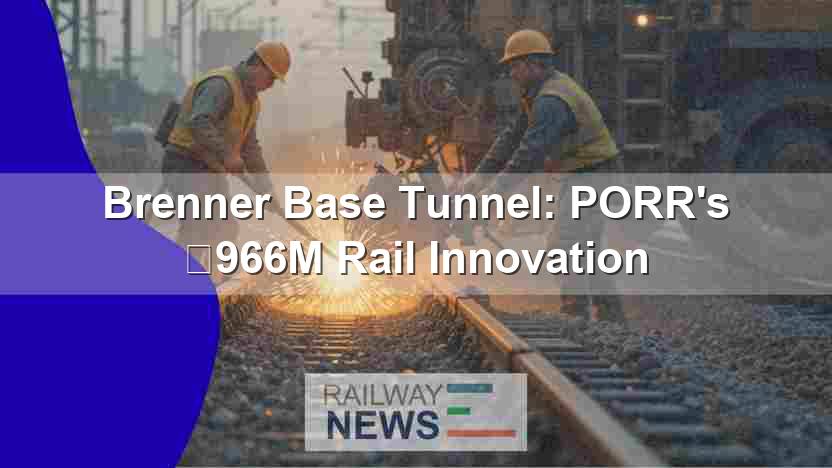
This article explores the significant €966 million contract awarded to a PORR consortium for the construction of a crucial 18km section of the Brenner Base Tunnel (BBT) connecting Austria and Italy. The project highlights the complexities involved in large-scale, high-speed rail infrastructure development, particularly concerning challenging geological conditions and logistical constraints. We will examine the scope of work, the technological challenges involved in tunnel boring, the project management considerations necessary for such a large undertaking, and the broader implications of the BBT for European rail transport. This analysis will explore the multifaceted aspects of this ambitious project, offering insights into the engineering, logistical, and economic considerations that define such monumental feats of civil engineering.
The Brenner Base Tunnel Project: A European Landmark
The Brenner Base Tunnel (BBT), a 64km-long railway tunnel, is one of Europe’s largest and most complex infrastructure projects. Its purpose is to create a high-speed rail link between Austria and Italy, significantly improving cross-border travel and freight transport. The project’s importance extends beyond national borders, contributing to the development of a more efficient and sustainable European transportation network. The awarding of the €966 million contract to the PORR consortium, comprising PORR and its subsidiary Hinteregger, along with Italian partners Società Italiana per Condotte d’Acqua and Itinera, underscores the scale and significance of this undertaking. The contract specifically covers Lot H51, the Pfons-Brenner section, encompassing the construction of two main tunnel tubes and related infrastructure.
Engineering Challenges and Technological Solutions
Constructing the Pfons-Brenner section presents considerable engineering challenges. The variable geological conditions along the 18km route demand flexible and adaptable construction methods. The use of Tunnel Boring Machines (TBMs) with a 10.37m excavation diameter is a testament to the project’s technological sophistication. The planned excavation rate of up to 30m per day, per TBM, illustrates the ambitious timescale and the need for efficient and precise execution. Alongside the TBM work, the drill and blast method will be employed for exploratory shaft excavation, requiring meticulous safety protocols and efficient shotcrete (a type of sprayed concrete) application for stabilization.
Project Management and Logistical Considerations
Managing a project of this magnitude requires exceptional project management capabilities. The tight deadlines, complex logistics, and the need for coordination between numerous stakeholders across national borders represent considerable hurdles. The project’s success hinges on effective risk management strategies that account for geological uncertainties, potential equipment failures, and workforce management. The single access shaft approach adds another layer of complexity, requiring meticulous planning and execution to manage material flow, personnel access, and the removal of excavated materials.
Economic Impact and Wider Significance
The Brenner Base Tunnel is not merely a construction project; it is a significant investment with far-reaching economic implications. The project will facilitate increased trade between Austria and Italy, bolstering economic growth in the region. It will also reduce reliance on road transport, contributing to environmental sustainability through decreased carbon emissions. Additionally, the project will generate numerous jobs throughout its construction phase, stimulating economic activity within the construction industry and related sectors. The success of the project has profound implications for Europe’s broader rail transportation infrastructure and its commitment to integrated, high-speed rail networks.
Conclusion
The awarding of the €966 million contract to the PORR consortium for the construction of the Pfons-Brenner section of the Brenner Base Tunnel marks a significant milestone in the realization of a crucial European infrastructure project. The project’s scope encompasses considerable engineering and logistical challenges, from navigating diverse geological conditions to managing the complex interplay of stakeholders and resources. The utilization of advanced Tunnel Boring Machines (TBMs) and the efficient application of drill and blast methods for exploratory shafts, coupled with rigorous project management strategies, are critical for meeting the ambitious timeline and budget. The successful completion of the BBT will not only enhance high-speed rail connectivity between Austria and Italy, but also stimulate regional economic growth and contribute towards a more sustainable transportation system in Europe. The project serves as a case study in large-scale infrastructure development, highlighting the complexities involved in planning, executing, and managing such monumental undertakings. The integration of sophisticated technology, meticulous project management, and international collaboration are essential components of this successful endeavor and should serve as a template for future large scale infrastructure projects across the world. The long-term benefits of increased trade, reduced environmental impact, and enhanced regional connectivity underscore the substantial contribution of the Brenner Base Tunnel to the future of European transport.

Railway infrastructure, rolling stock and transport technologies specialist focused on global rail industry developments, high-speed rail systems, signaling technologies and freight transportation. Covering railway investments, public transport modernization, rail operations and international mobility projects across Europe, Asia and North America.
RELATED POSTS

September 5, 2026 4:19 pm
CPK launched formal tender talks with four consortia to design...

September 6, 2026 4:12 am
Alstom delivered the first of 100 new G Class trams...
September 5, 2026 6:17 pm
Universal Signalling won a deal to install its U-Cross system...

September 6, 2026 8:17 am
DB InfraGO reopened the Nuremberg-Regensburg line in Bavaria on 31...
September 6, 2026 12:20 pm
Indian Railways ordered a probe after a fire destroyed 2...
September 7, 2026 11:16 pm
China Railway Tunnel Group completed the 11.3-km underwater Yangtze tunnel...