
Battery Trains: Europe’s Electrification, GWR & Stadler Insights
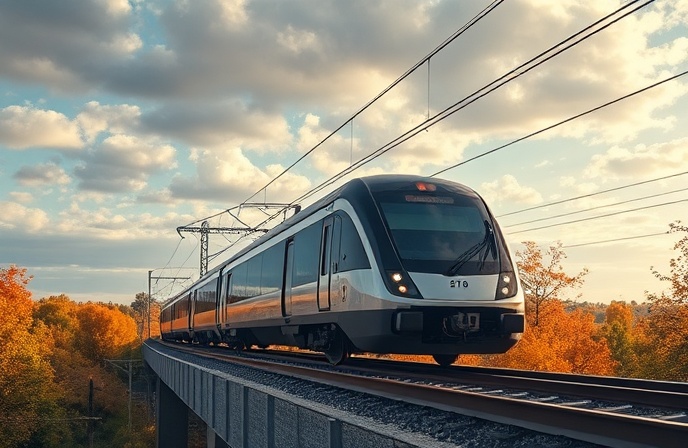
Great Western Railway’s successful 200-mile journey showcases the potential of **battery-powered trains** to electrify the **railway** network across Europe.
“`html
Introduction
Great Western Railway (GWR) completed a 200-mile journey with its modified Class 230 train on a single charge, demonstrating the feasibility of battery-powered trains for electrifying large sections of the European railway network.
Electrification Efforts in Europe
The European rail community has long aimed for a fully electrified railway network, recognizing economic, environmental, and performance benefits. However, electrification percentages vary significantly across countries. Battery-powered trains are proposed to address electrification gaps. GWR’s achievement follows a year-long trial on the West Ealing to Greenford line, where a converted Class 230 equipped with flash-charging capabilities achieved a total cost of ownership of £2.52 per train mile, significantly lower than the £4.50 of its diesel counterpart, and reduced carbon emissions by 80% compared to diesel equivalents. According to European Union statistics, 60% of the European rail network is electrified, with 80% of traffic running on these lines. Switzerland boasts a 99.8% electrification rate, while Denmark lags at 32.3%.
Stadler’s FLIRT Akku Battery Trains
Danish regional operator, Lokaltog, has ordered 10 additional FLIRT Akku battery trains from Stadler to overhaul its diesel fleet. These battery-electric multiple units (BEMUs), already in operation in Germany and other countries, accommodate around 200 passengers, offer up to 100km of battery-only range, and charge via overhead lines or regenerative braking. These trains are a solution for electrifying routes with limited overhead lines. The trains can be equipped with different propulsion and battery chemistry options. However, questions remain regarding battery performance, safety, and lifetime for those looking to adopt battery rolling stock.
Battery Chemistry Options and Considerations
Common battery chemistry options include NMC-Graphite, LFP-Graphite, and NMC-LTO. NMC-Graphite and NMC-LFP are generally suited for longer distances with fewer stops, while LFP-Graphite is used where space is less constrained, and NMC-LTO is used on shorter routes with frequent stops. Chemistry influences battery safety and lifetime. NMC-Graphite batteries are more sensitive to higher temperatures and fast-charging. NMC-Graphite and LFP-Graphite chemistries suffer from lower power and capacity in colder temperatures. NMC-LTO is less susceptible to hot or cold temperatures and can fast-charge more easily but offers lower energy density. The ‘flatter’ voltage profiles of LFP-Graphite and NMC-LTO can complicate battery state-of-charge and state-of-health tracking. Battery management systems may require scheduled deep discharge or full charge events to correct themselves. Cost differences at the chemistry level even out as the cost of the pack and surrounding battery system is factored in.
Advancements in Battery Technology
An ideal rail battery archetype would combine the long life, fast-charging, and wide-temperature tolerance of NMC-LTO, with at least the energy density of LFP-Graphite, and with a system cost and voltage profile of NMC-Graphite. Innovation at the chemistry level is vital to achieving this performance. Sodium Ion technology and niobium-based lithium-ion chemistries, such as Echion Technologies’ XNO®, offer solutions. XNO® provides superior charge performance, leading to higher energy recovery during braking and reduced charge times. Under fast-charge conditions, energy density is similar to LFP-Graphite and 50% higher than NMC-LTO. It operates in extreme environments (-40 to 60°C), with a cycle life exceeding 20,000 cycles and can deliver the high power required by larger trains operating on longer routes. It has a safety profile similar to NMC-LTO, and a voltage profile that is easily tracked by BMSs, similar to NMC-Graphite.
Last June 2025, we published an article about Renfe’s Aranjuez maintenance hub. Click here to read – Future of Rail: Renfe’s Railway Technology Hub, Aranjuez: Essential Guide
Conclusion
European countries are taking steps to reduce emissions in the rail industry, the industry has the opportunity to achieve full electrification by embracing new battery chemistries that can deliver cleaner, better, and more affordable rail at scale.
Company Summary
Echion Technologies: Develops niobium-based lithium-ion chemistries, including XNO®, for battery applications.
GWR (Great Western Railway): A railway operator that completed a 200-mile journey with a modified Class 230 train.
Lokaltog: A Danish regional operator that has ordered FLIRT Akku battery trains.
Stadler: A manufacturer of FLIRT Akku battery trains.
Technology
BEMUs (battery-electric multiple units): Trains that operate using battery power.
LFP-Graphite: A battery chemistry using Lithium Iron Phosphate (LFP) for the cathode and Graphite for the anode.
NMC-Graphite: A battery chemistry using Nickel Manganese Cobalt (NMC) for the cathode and Graphite for the anode.
NMC-LTO: A battery chemistry using Nickel Manganese Cobalt (NMC) for the cathode and Lithium Titanate Oxide (LTO) for the anode.
XNO®: Echion Technologies’ niobium-based lithium-ion chemistry.
“`
RELATED POSTS

August 27, 2018 5:29 pm
The 2018 Turkey train derailment: A critical analysis reveals...
September 4, 2017 4:40 pm
Revolutionizing rail! Modern infrastructure investments and smart technologies are...
September 7, 2025 5:48 am
Nokia unveils 5G solution, crucial for FRMCS and future railway...
August 19, 2018 3:55 pm
Alstom Citadis X05 trams in Nice: Discover how innovative...
November 27, 2025 12:42 pm
TriMet's light rail fleet upgrades complete! Final Siemens S700 vehicle...
April 7, 2018 9:19 am
UK rail's revised penalty fare rules create a fairer system,...