
Barcelona Airport Rail: Enhanced Connectivity & Rail-Air Intermodality
Barcelona Airport rail link Phase 2 nears completion, boosting connectivity.
Barcelona-El Prat Airport Rail Link: Phase 2 Nears Completion, Promising Enhanced Connectivity
The buzz of construction continues around Barcelona-El Prat Airport, as Spanish infrastructure manager Adif nears the completion of Phase 2 of a crucial rail link connecting Terminal 1 (T1) to the city’s wider rail network. With 80% of the work finalized, the project remains on schedule for a year-end completion, according to the latest reports. This ambitious undertaking, part of the broader Transformem Rodalies (Transforming the commuter rail network) plan, aims to revolutionize access to the airport, improving connectivity and reducing travel times for millions of passengers annually. This article will delve into the key advancements of the project, highlighting the engineering feats and strategic importance of this new railway connection, setting the stage for seamless rail-air intermodality.
Tunneling and Underground Infrastructure: A Detailed Overview
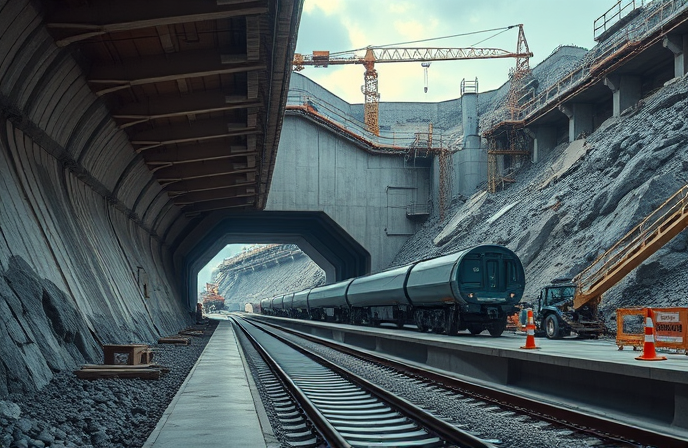
The backbone of this project is the 5.2 km double-track railway, a significant portion of which lies underground. The line originates on the standard-gauge Barcelona–Vilanova line and connects to the future station at T1, with an intermediate stop at Terminal T2. The 4.3 km underground section features a 3.1 km segment excavated using a Tunnel Boring Machine (TBM) during Phase 1. Within the tunnel, the project has seen considerable progress: construction in the cut-and-cover section is largely finished, along with concrete backfilling, and drainage systems. Crucially, side ducts for low- and medium-voltage railway installations have been built, alongside handrails for safety. Cable laying, and the installation of emergency lighting and fire protection systems, are also complete. The recent award of two contracts, valued at over EUR 4.4 million, further supports the project, covering the critical main and backup power supply connections.
External Track and Infrastructure Development
Beyond the subterranean realm, the external infrastructure, built on the existing standard-gauge tracks, has seen significant development. The construction includes geotechnical treatments to stabilize the ground, the construction of the pergola and its associated structures, and the load testing and commissioning of the track running beneath the pergola. Further developments include the access ramp for the branch lines, and the construction of embankments and railway platforms for the pergola connections, along with an expansion of the track platform for Track 4, an extension of a siding from El Prat station. For electrification, catenary masts and gantries have been installed across the new platform for Track 4, and on Tracks 1, 2 and 3, preparing the line for operational use.
Station Construction and Passenger Facilities
Adif’s progress also encompasses the construction of the airport’s underground stations. At T1, the construction of platforms and railway installation ducts is complete, alongside the installation of low- and medium-voltage systems, air conditioning, and comprehensive fire protection. Passenger experience is a priority, with the addition of lifts and emergency staircases. Technical rooms and crucial communication cores have also been built. At T2, significant work has focused on the station entrance structure, including fireproofing, as well as the installation of skylight roof panels, ventilation openings, and skylight framework. Railway installation chambers and ducts have been built on the platforms, while electrical, HVAC, and fire protection systems have been installed at the concourse level, on platforms, and in emergency stairwells. Completion of technical rooms on each level and public areas on the concourse level round out the passenger experience, enhancing accessibility and efficiency.
Track and Electrification Advancements
Key track and electrification works are also in progress. The project has seen the installation of several turnouts for the future branch line to the airport, alongside the laying of the ballast bed for Track 2, sleeper installations, and rail mounting. Ongoing work focuses on electrification, and track upgrades to allow a seamless integration into the existing rail network. This process includes the installation of catenary masts and gantries. These developments are critical to ensuring the railway can meet future operational demands.
Conclusion
The ongoing construction of the Barcelona-El Prat Airport rail link represents a pivotal moment for the region’s transportation infrastructure, with completion expected by the end of this year. The project’s multifaceted approach, incorporating tunnel construction, external track development, station upgrades, and electrification efforts, underscores the comprehensive nature of this infrastructure investment. Upon completion, the rail link is poised to provide significant benefits to public transport users, enhancing rail-air intermodality, and facilitating direct services between the airport’s two terminals and central Barcelona, and the wider Rodalies network. The predicted journey time of just 19 minutes between Terminal 1 and Sants Station, coupled with the estimated 7 to 9 million annual passengers expected to utilize the new railway, underscores the project’s transformative potential. This strategic investment, valued at over EUR 400 million, will play a crucial role in the Barcelona rail network’s future, setting a new standard for airport connectivity.
RELATED POSTS

March 6, 2026 12:10 pm
Consortium Announces Digital Services Platform for UK Rail Sector A...

March 5, 2026 7:57 pm
Banedanmark launched battery train operations on Denmark's 67 km Skjern–Holstebro...

March 5, 2026 4:23 am
Renfe suspends Spain rail services on Madrid-Andalusia corridor until February...
March 6, 2026 4:07 pm
Digital Subscription Market Analysis Q1 2026 Analytics firm Antenna confirmed...

March 4, 2026 10:12 am
Amtrak and Siemens deploy 8 Airo trains for the U.S....

March 4, 2026 2:06 pm
Alstom commissioned 76 Flexity LRVs and CBTC signaling for Toronto,...