
Bahn 2000 Railway Modernization Project: Switzerland, Zurich, Bern
Switzerland’s Bahn 2000 railway modernization project, completed after facing challenges, dramatically improved its network’s speed and capacity. This railway sector news highlights its lasting impact.
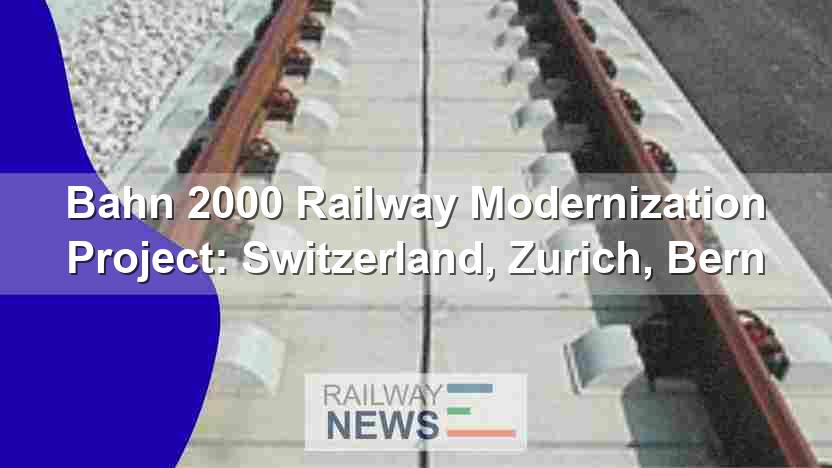
This article explores the Bahn 2000 project, a significant undertaking aimed at modernizing and expanding Switzerland’s railway network. The project’s goals were ambitious: to dramatically improve journey times between major Swiss cities, increase service frequencies, introduce new rolling stock, and enhance station facilities. This involved a substantial investment, funded in part by increased taxes on road transport. The project faced significant challenges, including unforeseen environmental costs and the need to balance national ambitions with regional concerns. This analysis will delve into the technical aspects of the Bahn 2000 program, examining the infrastructure improvements, technological innovations, and the overall impact on the Swiss railway system. We will also review the project’s successes, challenges, and its lasting legacy on railway infrastructure development and planning.
Infrastructure Upgrades and Capacity Expansion
Bahn 2000 involved a detailed overhaul of Switzerland’s railway infrastructure. Key projects included line quadrupling, the construction of new tunnels and flyovers, and extensive station remodeling. For instance, the quadrupling of the line to Rupperswil, along with the new Aarau city tunnel, facilitated the introduction of a half-hourly service between key cities like Bern, Zurich, Fribourg, and St. Gallen. The new 45km direct route between Rothrist and Mattstetten, enabling trains to reach speeds of 200km/h, significantly reduced travel times between Zurich and Bern. Similarly, improvements around Zurich Hauptbahnhof (Zurich main station), Switzerland’s busiest station, involved a CHF 1.3 billion investment to boost capacity by 40%. This included the construction of a flyover in Basel to eliminate crossing conflicts, improving efficiency. The widening of the Gütsch tunnel accommodated double-decker trains, resolving a significant bottleneck near Lucerne. The construction of the 10km tunnel between Zurich and Thalwil alleviated congestion on the lakeshore line. The project also included the construction of new tunnels like the Gotthard Base Tunnel (GBT) (57km) and the Lötschberg Base Tunnel (LBT) (35km), aiming to improve international connectivity and reduce journey times between Basel and Milan.
Technological Advancements and Rolling Stock
Bahn 2000 was marked by the introduction of advanced railway technology. The project saw the deployment of 44 new tilting trains, capable of speeds up to 200km/h, significantly improving journey times on Switzerland’s undulating terrain. These trains, built by a consortium of Adtranz, Fiat-SIG, and Schindler Waggon, offered a substantial increase in seating capacity compared to conventional carriages. The project also integrated double-decker trains (IC2000), each capable of carrying up to 1,400 passengers, further enhancing passenger capacity. Although the initial plan was to implement the European Train Control System (ETCS), practical challenges led to the adoption of conventional signalling systems as a fallback, with future plans to incorporate moving block systems. The project also involved the commissioning of 40 new signal boxes by December 2004, enhancing network control and safety.
Project Funding and Political Aspects
The Bahn 2000 project had a total budget of CHF 30.5 billion (€19.8 billion). A crucial aspect was the public’s support; Swiss citizens voted in favor of the project in 1987 and 1992 referendums, approving funding through increased taxes on road transport (lorries and petrol). However, the project faced delays due to unexpected environmental costs and regional concerns, leading to a temporary halt in 1995. The project’s success was tied to the ability to balance national-level strategic goals with regional interests, requiring extensive stakeholder consultation and political negotiation.
Project Summary and Impact
The Bahn 2000 project was a large-scale undertaking that had a substantial impact on Switzerland’s railway network. While it faced delays and challenges, it ultimately led to significant improvements in infrastructure, capacity, and passenger experience. The project demonstrates the importance of integrating technological advancements and careful planning, along with addressing environmental and regional considerations during large-scale infrastructure projects. The successful implementation of many elements, even amidst challenges, speaks to the power of strong public support for such initiatives.
| Project Aspect | Details |
|---|---|
| Project Name | Bahn 2000 |
| Total Budget | CHF 30.5 billion (€19.8 billion) |
| Project Duration | Multiple phases, spanning several decades |
| Type of Project | Railway infrastructure modernization and expansion |
| Key Connections | Zurich, Bern, Geneva, Lausanne, Basel, St. Gallen, Lucerne, Sion, Milan |
| Number of New Tilting Trains | 44 |
| Number of New Signal Boxes | 40 |
| Capacity Increase at Zurich Hauptbahnhof | 40% |
| Investment in new rolling stock | CHF 2.3 billion (€1.54 billion) |
Conclusions
Bahn 2000, despite its challenges and delays, stands as a testament to the ambitious goals and substantial achievements in Swiss railway modernization. The project’s success hinges on a multifaceted approach encompassing technological innovation, careful infrastructure planning, and significant public investment. The integration of tilting trains, double-decker carriages, and upgraded signaling systems dramatically enhanced the efficiency and capacity of the Swiss rail network. Key infrastructure developments, such as the Rothrist-Mattstetten line and the Zurich Hauptbahnhof improvements, showcase the transformative impact of targeted investments. While the project faced setbacks due to unforeseen environmental costs and the complex process of balancing national ambitions with regional concerns, its completion signifies a milestone in enhancing Switzerland’s connectivity and its robust rail transportation system. The project’s legacy extends beyond mere infrastructure improvements, underscoring the crucial role of public support and collaboration in realizing large-scale transport projects. It serves as a valuable case study for other nations seeking to modernize their railway systems, highlighting the need for a holistic approach that considers both technological advancements and the broader societal and political context. Future development, as projected by SBB (Swiss Federal Railways), further emphasizes the ongoing evolution of the Swiss railway network, positioning it for continued growth and improved connectivity within Switzerland and internationally.
Company Information:
- SBB (Swiss Federal Railways): The national railway company of Switzerland, responsible for the planning and execution of Bahn 2000.
- Adtranz: A former manufacturer of railway rolling stock, now part of Bombardier Transportation.
- Fiat-SIG: A consortium involving Fiat and Schweizerische Industrie Gesellschaft (SIG), a Swiss engineering company.
- Schindler Waggon: A Swiss railway rolling stock manufacturer.

Railway infrastructure, rolling stock and transport technologies specialist focused on global rail industry developments, high-speed rail systems, signaling technologies and freight transportation. Covering railway investments, public transport modernization, rail operations and international mobility projects across Europe, Asia and North America.