
Azerbaijan Railways: AC Conversion on Baku-Boyuk Kasik Line
Azerbaijan Railways completes AC power conversion on 122km section, boosting efficiency and safety on Baku-Boyuk Kasik line.
“`html
Introduction
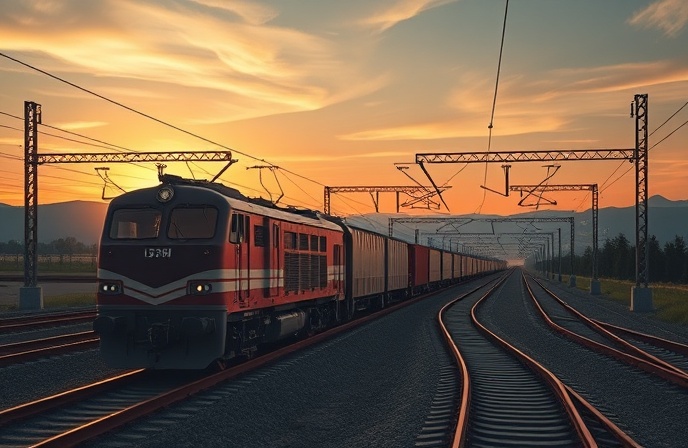
Azerbaijan Railways (ADY) has finalized the conversion to alternating current (AC) power on the 122 km Ujar-Hajigabul section of the Baku-Boyuk Kasik railway line. This upgrade includes the introduction of a Multi-Process Management (MPM) system and is expected to enhance efficiency, reduce energy consumption, and improve safety standards.
Last June 2025, we covered Renfe’s new, state-of-the-art Aranjuez maintenance hub, focusing on its impact on Cercanías efficiency. Click here to read – Future of Rail: Renfe’s Railway Technology Hub, Aranjuez: Essential Guide
AC Power Conversion
The conversion to AC power on the Ujar-Hajigabul section has been completed, with successful test runs for both freight and passenger trains. This shift to AC power enhances the traction capabilities of electric locomotives. The project involves electrifying 502 km of lines with 25 kV, 50 Hz AC, initially supplied with direct current (3.3 kV), between Baku on the Caspian Sea and Boyuk-Kasik on the Georgian border. Azerbaijan Railways has already converted 254 km of the line from Boyuk-Kasik to Ujar via Gandja, with the final 127 km section from Hajigabul to Baku scheduled for completion by 2027. Upon completion, the entire Baku-Boyuk Kasik railway will operate on 25 kV AC.
Modernization of Systems
To improve operational efficiency, communication and signalling systems along the Ujar–Hajigabul section have been modernized. As part of this upgrade, ADY introduced a Multi-Process Management (MPM) system, enabling simultaneous operation of signalling, communication, and control processes. Signalling systems are also being upgraded.
Operational Benefits
The upgrade to AC power is expected to increase freight volumes, speeds, and operational efficiency while delivering significant energy savings. The shift to centralised and modern management reduces train intervals and increases freight handling capacity. With these improvements, freight volumes are expected to grow, transport costs will decline, and transit routes across Azerbaijan will become more competitive compared to sea and road transport.
Strategic Alignment
The Baku-Boyuk Kasik railway is part of the Baku-Tbilisi-Kars (BTK) corridor. Switching to the AC system will increase the annual freight capacity on the BTK to 5 million tonnes. This upgrade integrates the Port of Baku into the rail network, minimizes time losses, and reduces logistics costs. By adopting this system, Azerbaijan aligns its strategic rail infrastructure with global standards, preparing it for long-distance, high-capacity operations.
Conclusion
The completed conversion to AC power on the Ujar-Hajigabul section of the Baku-Boyuk Kasik railway line by Azerbaijan Railways represents a significant upgrade. It is anticipated to enhance operational efficiency and align the railway with global standards.
Company Summary
Azerbaijan Railways (ADY): The national railway company of Azerbaijan, responsible for the operation and maintenance of the country’s railway network.
Technology
Multi-Process Management (MPM): An advanced technology enabling signalling, communication, and control processes to operate simultaneously.
“`
RELATED POSTS
LA Metro's A Line extension opens, boosting rail service to...

August 18, 2016 2:37 pm
Part of the Thameslink Programme, Network Rail trialed a track...
April 20, 2025 3:05 am
The Łódź Railway Tunnel Project: A Case Study in High-Speed...
June 16, 2025 11:01 am
Renfe Breaks Ground on Digitalized Maintenance Hub in Aranjuez Renfe,...

July 3, 2025 2:33 am
Rome's Metro Line C expands, adding 4 km to its...
October 17, 2025 1:54 pm
Deutsche Bahn unveils the new ICE L **train**, featuring enhanced...