
Austria’s Hydrogen Rail: Linz Station’s Sustainable Tech
Austria unveils world’s first hydrogen-powered rail at Linz station, a landmark for sustainable transport. ÖBB and voestalpine collaborated on this green initiative.
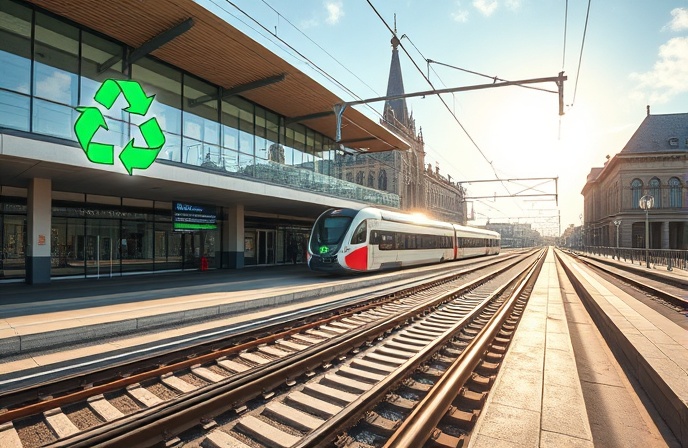
Austria Unveils World’s First Hydrogen-Powered Rail at Linz Central Station
In a landmark achievement for sustainable rail transport, Austrian Federal Railways (ÖBB) and steel technology giant voestalpine have jointly installed the world’s first rail manufactured using hydrogen-based input material. The groundbreaking installation, which took place at Linz Central Station on [DATE, deduced from the text: today], marks a significant step towards climate-neutral mobility. Austrian Federal Minister Peter Hanke, Upper Austria Governor Thomas Stelzer, and Regional Infrastructure Minister Günther Steinkellner were in attendance to witness the event. This innovation, a product of “Made in Austria” ingenuity, answers the “How” and “Why” of sustainable railway infrastructure, demonstrating a commitment to both environmental responsibility and economic competitiveness. The hydrogen-powered rail represents a crucial advancement in decarbonizing the railway industry, highlighting Austria’s leadership in railway technology and its dedication to building a more sustainable future for transport. The “What” is a rail made using green hydrogen and recycled material, the “Where” is Linz Central Station, and the “Who” are the collaborative efforts of ÖBB and voestalpine.
Pioneering Zero-Emission Steel Production
The core innovation lies in the manufacturing process. The rail is produced using green hydrogen, replacing traditional fossil fuels, resulting in net-zero CO₂ emissions during production. This is a major technological breakthrough, paving the way for truly sustainable rail infrastructure. Voestalpine’s approach to green steel production extends beyond this single project. The company has already invested in two electric arc furnaces powered by green electricity at their Linz and Donawitz sites. Moreover, voestalpine is conducting extensive research, partnering with industry and academic institutions, to develop advanced technologies that further minimize their environmental footprint. This holistic approach to sustainable steel production is critical to realizing the environmental benefits of this new rail technology.
Integrating Circular Economy Principles
Beyond its hydrogen-based production, the new rail incorporates sustainable principles through its material composition. The rail is entirely manufactured from recycled materials, supporting a circular economy model. This further reduces the environmental impact, minimizing waste and promoting resource efficiency. The utilization of recycled materials reinforces Austria’s commitment to sustainability across all stages of the rail’s lifecycle. This commitment to circularity represents a critical step in the railway industry’s pursuit of eco-friendly practices, with implications for the sourcing of materials and overall operational efficiency. The rail’s production also illustrates the potential of regional value creation. Manufactured at voestalpine’s Donawitz site in Styria, the rail was delivered “just-in-time” to Linz Central Station, highlighting efficient logistics and regional collaboration.
Driving Infrastructure Upgrades and Enhancing Regional Connectivity
The installation of the hydrogen-powered rail is part of the ongoing infrastructure upgrades at the west exit of Linz Central Station. This is a vital component of the four-track expansion project of the Westbahn route connecting Vienna to Wels. The project, focused on improving rail services throughout the Upper Austrian central region, unlocks new capacity for future rail transport. The “Linz Central Station – West Side” project includes the introduction of four tracks, which will eliminate the current bottlenecks and improve regional and express train services. Passengers will benefit from a denser S-Bahn (suburban railway) network in the Linz-Wels corridor, an integrated regular-interval timetable, and the construction of new, modern, and barrier-free stations complete with Park & Ride facilities. The expansion ensures a more efficient and reliable transportation network throughout Upper Austria.
Austria’s Leadership in Sustainable Railway Technology
The collaboration between ÖBB and voestalpine exemplifies the strength of the Austrian rail industry and its commitment to climate protection. This hydrogen-based rail is proof that the Austrian rail industry is ready to make history, not just be a part of it. The initiative proves that climate-neutral steel, modern rail infrastructure, and sustainable mobility can be realized. The project signifies the region’s advantages: smart minds, skilled hands, and innovative businesses. The hydrogen-based rail supports the development of infrastructure that is both environmentally friendly and efficient. It demonstrates Austria’s leadership and underscores the nation’s dedication to sustainability. Austria’s experience in creating hydrogen-based rail is vital for the future of sustainable rail transport around the world, setting a new standard for the industry.
Conclusion
The unveiling of the world’s first hydrogen-powered rail at Linz Central Station represents a watershed moment for the global railway industry. This milestone, achieved through the collaborative efforts of ÖBB and voestalpine, showcases a practical and scalable solution for significantly reducing the carbon footprint of rail transport. The use of green hydrogen, coupled with recycled materials, demonstrates a commitment to both technological innovation and environmental responsibility. The project’s impact extends beyond the immediate reduction in emissions. It highlights the importance of regional value creation and the potential for enhanced connectivity through infrastructure upgrades. This forward-thinking initiative positions Austria as a global leader in sustainable railway technology, showcasing a model that can be replicated internationally. The development of the hydrogen-based rail is a prime example of how the industry can leverage innovation to drive positive change, opening up new avenues for research and development. The successful implementation of this initiative suggests that the future of rail transport lies in cleaner, greener, and more sustainable technologies. As the world increasingly focuses on decarbonization, Austria’s commitment to hydrogen-based rail promises to inspire and inform the industry’s next phase of growth.
Company Summary
ÖBB (Austrian Federal Railways): ÖBB, Austria’s national railway operator, is a key player in European rail transport. Its operations encompass passenger and freight services, infrastructure management, and railway station operations. ÖBB is actively investing in upgrading and expanding the national rail network, promoting sustainable mobility solutions, and exploring innovative technologies to enhance efficiency and reduce environmental impact.
voestalpine: voestalpine is a leading global technology and capital goods group specializing in steel production and processing. The company’s Rail Technology division produces high-quality rails, switches, and other components for railway infrastructure. Voestalpine is driving innovation in the steel industry by focusing on green steel production and exploring technologies that contribute to a sustainable and circular economy.
RELATED POSTS

July 5, 2019 8:31 am
The Electrification of German Regional Rail: NAH.SH’s Adoption of Stadler’s...
May 29, 2025 9:00 am
The Short Line Safety Institute (SLSI) recently unveiled its annual...
February 16, 2023 6:54 am
This article examines the Victorian Government’s initiative to enhance the...
December 29, 2019 3:40 pm
The Doha Metro: A Case Study in Modern Rapid Transit...
April 26, 2022 5:55 am
Modernizing the Harwich Branch Line: A Case Study in Railway...
August 1, 2021 1:01 pm
Introduction This article examines the significant investment by the European...