
American Solar Rail Wins Innovation Award for Sustainable Rail System
American Solar Rail wins the Railway Technology Excellence Award for its sustainable innovation. The groundbreaking Railway Transportation System promises faster, efficient rail travel.
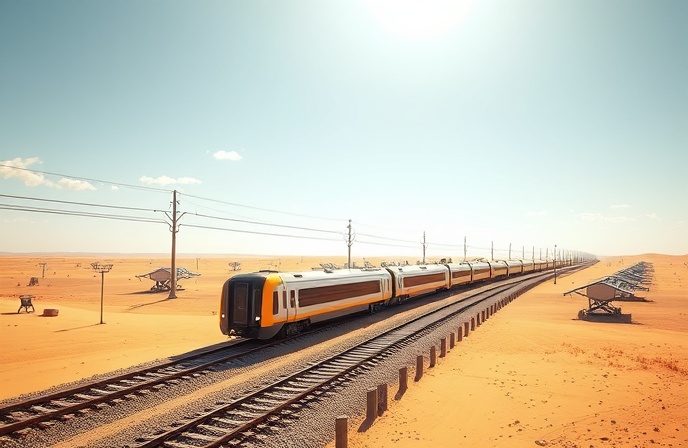
American Solar Rail (ASR) has been honored with the prestigious 2025 Railway Technology Excellence Award for Innovation in Sustainable Rail, recognizing its groundbreaking Railway Transportation System. This award highlights ASR’s potential to revolutionize passenger rail by significantly reducing end-to-end delivery times, lowering lifecycle energy costs, and offering a scalable solution on existing infrastructure.
| Key Entity | Critical Detail |
|---|---|
| Award Recipient | American Solar Rail (ASR) |
| Award | 2025 Railway Technology Excellence Award for Innovation in Sustainable Rail |
| Core Innovation | Railway Transportation System with in-transit battery recharging and continuous-motion passenger exchange (EMDI®) |
| Key Benefits | Shorter end-to-end passenger delivery times, reduced lifecycle energy costs, scalable path to modern passenger rail on existing infrastructure. |
| Feasibility Review | 21-month review by MxV Rail (AAR subsidiary) found no single unfeasible item; advanced technical advisory and safety case recommended. |
| Regulatory Engagement | Active engagement with the Federal Railroad Administration (FRA) for prototype development and certification within existing battery-electric standards. |
| Operational Model | Focus on reducing dwell time through continuous-motion passenger exchange, enabling city-to-city times competitive with 150-200 mph operations. |
| Energy Integration | Integration of corridor-sited solar generation and distributed Battery Energy Storage Systems (BESS) for propulsion and in-transit recharging. |
American Solar Rail’s innovative approach reframes rail performance by prioritizing time saved over solely increasing top speeds. The company’s patented Railway Transportation System, including the EMDI® (Embarkation/Disembarkation) railcar, addresses the significant time penalty incurred by traditional station stops. By enabling continuous-motion passenger exchange, ASR effectively turns station dwell time into travel time, allowing for more frequent stops without compromising overall journey competitiveness. This system integrates corridor-sited solar generation and distributed Battery Energy Storage Systems (BESS) to power battery-electric propulsion and facilitate in-transit battery recharging, eliminating the need for costly catenary infrastructure.
Strategic Impact and Feasibility
The strategic implications of ASR’s technology are substantial. By operating on existing Class 5-6 corridors with targeted upgrades, the system promises to bring fast, frequent passenger service to hundreds of mid-sized communities. Modeling suggests that removing dwell time can reduce total trip time by 20-30%, making city-to-city times competitive with higher-speed operations on less demanding track infrastructure. A detailed 21-month feasibility review conducted by MxV Rail, a subsidiary of the Association of American Railroads (AAR), concluded that no single element would render the system unfeasible, recommending the advancement of a technical advisory process and safety case. This rigorous independent validation underscores the system’s viability.
Operational Innovation and Energy Integration
At the core of ASR’s innovation is the EMDI® system, which allows passengers to board and alight while the train maintains a significant portion of its speed. A battery-powered EMDI unit couples with a slowing mainline train, facilitates passenger exchange, and transfers energy to the train while in motion, before proceeding to the next depot for recharging. This continuous-motion exchange is supported by advanced sensor-guided alignment and precise traction control. Additionally, ASR redefines railway energy management by integrating renewable energy generation directly into the right-of-way. Corridor-sited solar arrays feed distributed BESS, which not only power electric traction and support in-transit recharging but also create a “solar-rail spine.” This spine can supply energy to nearby uses, such as EV charging, transforming the railway from an energy cost center into a revenue-producing asset and enhancing overall grid resilience.
Industry Context
Last June 2025, we published an article about Renfe’s cutting-edge Aranjuez maintenance hub. Click here to read – Future of Rail: Renfe’s Railway Technology Hub, Aranjuez: Essential Guide
For railway executives and stakeholders, American Solar Rail’s achievement represents a paradigm shift in passenger rail development. The company’s focus on eliminating dwell time and leveraging existing infrastructure offers a more capital-efficient and rapidly deployable path to modernizing passenger services, particularly in underserved corridors. The integration of renewable energy generation and storage within the railway ecosystem presents a compelling model for decarbonization and operational resilience, moving beyond traditional utility dependence. With active engagement with the Federal Railroad Administration (FRA) and a clear plan for prototype development and phased deployment, ASR’s approach addresses the critical need for affordable, sustainable, and time-efficient passenger rail solutions that can achieve significant impact in the near term.

Railway infrastructure, rolling stock and transport technologies specialist focused on global rail industry developments, high-speed rail systems, signaling technologies and freight transportation. Covering railway investments, public transport modernization, rail operations and international mobility projects across Europe, Asia and North America.
RELATED POSTS

October 1, 2026 7:09 am
United States regulators confirmed a September 30 deadline for the...

October 8, 2026 1:15 pm
Alstom secured a €1bn contract to build 13 automated trains,...

October 4, 2026 5:14 pm
Alstom secured a CA$4.7 billion order from VIA Rail Canada...

October 1, 2026 12:13 am
Illinois approved $1.5 billion annually for the Northern Illinois Transit...
October 6, 2026 2:14 am
Union Pacific launched export rail shipments with Ferromex to deliver...

October 1, 2026 6:10 am
Amtrak approved a System Expansion Committee on July 30 to...