
Alstom’s ERTMS: Modernizing Norway’s Rail
Norway’s rail network is getting a major ERTMS upgrade thanks to Alstom’s Atlas solution. Discover how this nationwide project boosts safety, efficiency, and capacity!
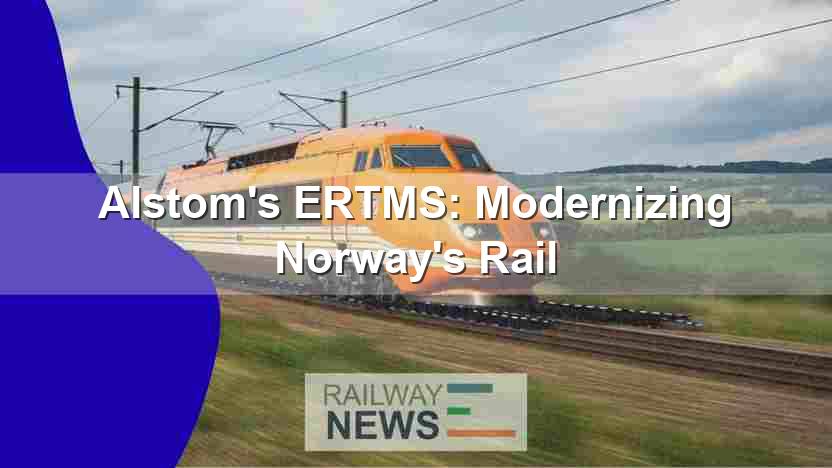
This article examines Alstom’s significant contract with Bane NOR (Norwegian National Rail Administration) for the installation and maintenance of European Rail Traffic Management System (ERTMS) onboard train control systems across the entire Norwegian railway fleet. This project represents a substantial modernization effort, aiming to enhance efficiency, reliability, and safety within Norway’s rail infrastructure. The scope of the project, spanning 467 trains of 55 different types, highlights the complexity and scale of integrating a unified signaling system across a diverse existing fleet. The subsequent sections will delve into the technical aspects of the ERTMS implementation, its operational benefits, the logistical challenges involved in such a widespread upgrade, and the long-term implications for the Norwegian railway system. We will also analyze the strategic choices made by Bane NOR and Alstom in selecting and implementing this solution.
ERTMS Integration: A Technological Leap for Norwegian Railways
The core of the project involves the deployment of Alstom’s Atlas ERTMS solution. ERTMS (European Rail Traffic Management System) is a sophisticated, interoperable signaling system designed to replace older, national-specific systems. Its adoption is key to improving safety and efficiency across Europe’s rail networks. In Norway, this means replacing the existing Automatic Train Control (ATC) system, and other legacy systems, with the modern ERTMS Level 2. Alstom’s solution is particularly noteworthy for its ability to operate seamlessly on both legacy lines equipped with ATC-2 and newer lines equipped with ERTMS Level 2. This dual-system compatibility minimizes disruption and maximizes the immediate benefits of the upgrade. The ingenious design minimizes equipment redundancy by sharing components, such as the balise antenna and the onboard computer, leading to cost savings and simplified maintenance.
Operational Benefits and Enhanced Safety
The successful implementation of ERTMS will bring several key operational advantages to the Norwegian railway system. The improved signaling system will allow for increased train speeds and higher train frequencies, boosting the capacity and punctuality of both passenger and freight services. Reduced delays due to signaling failures will also significantly contribute to network efficiency. Perhaps the most significant benefit is the enhancement of safety. ERTMS’s advanced features will reduce the risk of human error and improve the overall safety standards of the Norwegian rail network, ultimately protecting passengers and railway staff.
Logistical Challenges and Project Management
A project of this magnitude presents substantial logistical challenges. The installation of ERTMS on 467 trains of 55 different types necessitates meticulous planning and execution. Alstom’s collaboration with Bane NOR, involving 14 railway vehicle owners, underscores the collaborative approach required. The project’s timeline, with serial fittings commencing in 2021 and completion by September 2026, emphasizes the rigorous management needed to meet deadlines. Alstom leverages its ERTMS center of excellence in Charleroi, Belgium, working in conjunction with project offices in Oslo and the hardware development center in Villeurbanne, France, to effectively manage the complex technical aspects, ensuring timely and efficient progress. This global collaboration highlights the importance of shared expertise and centralized management in large-scale infrastructure projects.
Conclusion: A Modern, Efficient, and Safer Railway Network
Alstom’s contract with Bane NOR marks a transformative step for the Norwegian railway system. The nationwide rollout of ERTMS, utilizing Alstom’s Atlas solution, represents a significant investment in modernizing the nation’s rail infrastructure. The project’s scope, encompassing the entire Norwegian train fleet, underscores the commitment to improving efficiency, safety, and reliability. The integration of a dual-system compatible ERTMS solution demonstrates a forward-thinking approach, minimizing disruption while maximizing long-term benefits. The successful implementation of this project will not only enhance operational performance but also establish Norway as a leader in adopting modern, interoperable rail technologies. The collaborative effort between Alstom and Bane NOR, involving numerous stakeholders, highlights the complexities and collaborative nature of such large-scale infrastructure upgrades. The long-term implications are profound, promising a more efficient, safer, and technologically advanced railway network for passengers and freight operators alike. This successful deployment serves as a model for other nations seeking to upgrade their rail networks to the benefits of ERTMS and modern signaling technologies, setting a new benchmark for railway modernization projects globally. The efficient project management across multiple international sites underlines the global expertise and capability needed for the successful deployment of such sophisticated technology on a national scale. The future of Norwegian railways promises improved punctuality, increased capacity, and heightened safety, setting a new standard for rail travel.

Railway infrastructure, rolling stock and transport technologies specialist focused on global rail industry developments, high-speed rail systems, signaling technologies and freight transportation. Covering railway investments, public transport modernization, rail operations and international mobility projects across Europe, Asia and North America.
RELATED POSTS

October 1, 2026 7:09 am
United States regulators confirmed a September 30 deadline for the...

October 8, 2026 1:15 pm
Alstom secured a €1bn contract to build 13 automated trains,...

October 4, 2026 5:14 pm
Alstom secured a CA$4.7 billion order from VIA Rail Canada...

October 1, 2026 12:13 am
Illinois approved $1.5 billion annually for the Northern Illinois Transit...
October 6, 2026 2:14 am
Union Pacific launched export rail shipments with Ferromex to deliver...

October 1, 2026 6:10 am
Amtrak approved a System Expansion Committee on July 30 to...