
Alstom’s BEMU Strategy: Decarbonizing Rail in Europe & Beyond
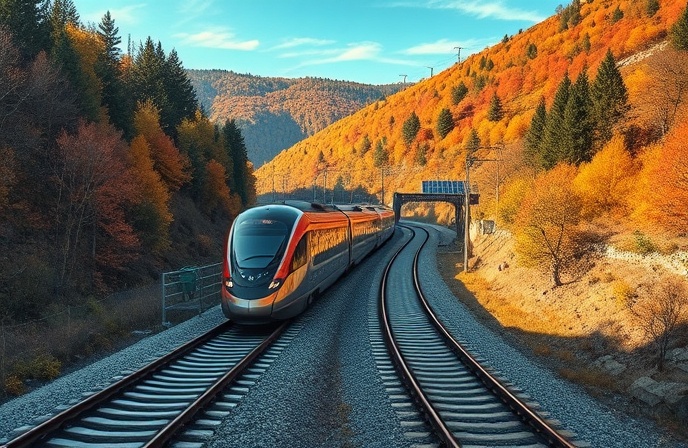
Alstom’s strategy for **railway decarbonization** using **BEMUs** was detailed at Railway Days 2025. Battery-electric trains offer a cleaner, faster path to zero-emission rail mobility.
“`html
Introduction
At the Railway Days 2025 conference in Bucharest, Nicolae Dragu, Rolling Stock Director at Alstom Transport Romania, discussed Alstom’s strategy for railway decarbonization using battery-electric multiple units (BEMUs).
Railway Decarbonisation Strategy
Nicolae Dragu addressed the need for efficient traction solutions that can operate on both electrified and non-electrified sections. He stated that while electrification is the most efficient long-term solution, BEMUs offer a faster, cleaner alternative. The BEMUs combine the performance of conventional electric trains with on-board battery systems that recharge under the catenary or through regenerative braking. When operating on non-electrified track, the train switches automatically to battery mode, maintaining identical comfort and speed levels while producing zero direct emissions.
BEMU Platforms and Operational Capabilities
Dragu explained that Alstom’s latest BEMU platforms, such as Coradia Continental and X’trapolis, provide ranges of 80–120 km in battery mode. These trains recharge at terminal stations or “charging islands” along the route. This concept is already used in Germany, France, and Ireland, enabling operators to extend electrified service without waiting for full network upgrades.
Applications and Benefits of BEMUs
Dragu highlighted that battery trains are effective for regional and commuter services. They require lower initial investment, have shorter delivery timelines, and can decarbonize transport on secondary lines where traffic density is moderate.
Sustainability and Circular Economy
The presentation also addressed the sustainability of battery systems. Alstom batteries are designed for a 7–10-year lifespan, after which they can be repurposed for stationary energy-storage applications. Up to 95% of materials can be recycled. Dragu highlighted Alstom’s “second-life” and recycling partnerships, noting that the company already offers full end-of-life solutions for traction batteries.
Last June 2025, we published an article about Renfe’s Aranjuez maintenance hub. Click here to read – Future of Rail: Renfe’s Railway Technology Hub, Aranjuez: Essential Guide
Conclusion
Dragu concluded that a unified approach between infrastructure and rolling stock is necessary. He emphasized that battery-electric trains are a cornerstone of Europe’s transition to zero-emission rail mobility.
Company Summary
Alstom Transport Romania: A division of Alstom, focused on providing railway solutions.
“`
RELATED POSTS

July 30, 2007 8:29 pm
Australia’s Queensland Rail (QR) says it will spend A$113m purchasing...

December 19, 2016 6:27 pm
Bombardier announced today that TransLink, Metro Vancouver’s regional transportation authority,...
October 14, 2025 3:54 pm
Romania secures a significant EUR 1.1 billion boost for **zero-emission...

May 5, 2017 12:56 pm
FCC Construcción has secured a €1.634bn contract from the Romanian...

October 18, 2017 2:07 pm
Optimize your railway network! The Hurstbridge Line upgrade reveals...

July 25, 2015 9:16 pm
Mitsubishi Electric Corporation announced today that it has completed the...