
AGP’s Nebraska Rail: Soybean Logistics & Infrastructure
New soybean processing plant in Nebraska, strategically located near multiple Class I railroads, will boost rail sector.
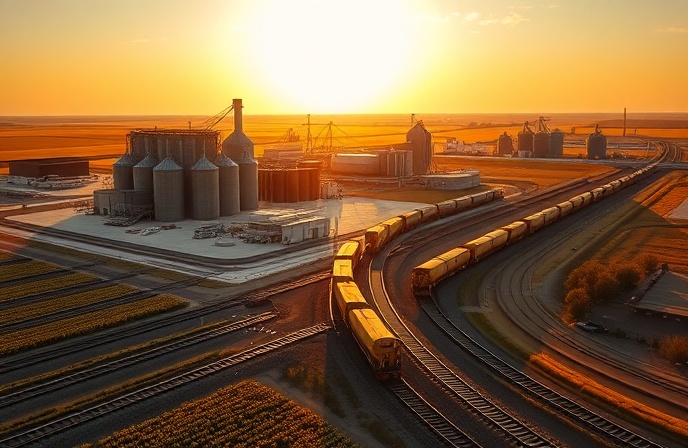
AGP Opens New Soybean Processing Plant, Fortifying Rail Infrastructure
In a move poised to significantly impact agricultural logistics and rail operations, Ag Processing Inc. (AGP) held a ribbon-cutting ceremony late last month to celebrate the completion of its new soybean processing and degumming facility in David City, Nebraska. This marks AGP’s 11th soybean processing location and is scheduled to commence commercial operations by the end of October. The new facility, which will process over 50 million bushels of soybeans annually, will produce nearly 700 million pounds of degummed oil. The location of the plant in David City, NE, was chosen because of its strategic access to multiple Class I railroads (Union Pacific and BNSF), as well as regional carrier Nebraska Central Railroad, highlighting the vital role rail transport plays in AGP’s supply chain. This article will examine the facility’s innovative approach to rail integration and the subsequent implications for the agricultural industry.
Strategic Rail Infrastructure
The David City facility’s design underscores the critical role of rail transport. Spanning a 273-acre site, the complex boasts approximately 13.6 miles of dedicated rail tracks, offering direct access to the Union Pacific Railroad (UP), BNSF Railway Co., and Nebraska Central Railroad Co. (NCRC). The substantial rail network within the plant ensures efficient handling of inbound soybeans and outbound products. AGP’s commitment to rail is evident in the design, with 2.5 miles of paved roads dedicated to internal transport to support the massive volume of rail shipments. This design allows AGP to capitalize on the efficiency and cost-effectiveness of rail for long-haul transportation, a crucial element in maintaining competitiveness in the agricultural market.
Maximizing Rail Capacity
The facility’s rail infrastructure is optimized for high-volume unit train operations. A “unit train”, a dedicated train of typically 100-110 cars, is loaded or unloaded in a single movement, maximizing efficiency. According to Lou Rickers, AGP Chief Operations Officer, “With the amount of rail track on site, AGP will load a unit train of 110 cars every three to four days.” The design allows the facility to simultaneously hold a loaded unit train ready for departure, receive an empty unit train, and build a third unit train of soybean meal. This operational model significantly streamlines logistics, minimizing turnaround times and maximizing the utilization of rail assets. This setup demonstrates AGP’s dedication to integrating best practices in railway and logistical capabilities.
Operational Efficiencies and Market Impact
The new facility promises substantial operational efficiencies. The ability to quickly handle unit trains, a critical advantage, is a key differentiator in the competitive agricultural market. By minimizing the time soybeans and products spend in transit, AGP can reduce transportation costs and ensure timely deliveries to its customers. This improved efficiency also supports the broader agricultural supply chain, contributing to lower prices and enhanced profitability for both producers and consumers. The facility’s capacity to process a significant volume of soybeans and produce degummed oil will solidify AGP’s position in the market and positively influence the regional economic landscape.
Conclusion
The opening of AGP’s new soybean processing facility in David City, Nebraska, represents a significant investment in the agricultural and rail sectors. The strategic design, centered around an extensive internal rail network, exemplifies a modern approach to logistics, maximizing efficiency and minimizing transportation costs. By integrating rail so thoroughly, AGP is well-positioned to capitalize on the benefits of unit train operations, improving turnaround times and overall supply chain performance. The resulting efficiencies will bolster AGP’s competitive position and benefit the agricultural economy. Looking ahead, this project serves as a case study for how other agricultural businesses can leverage rail infrastructure to streamline their supply chains. This model of optimizing rail access, as exemplified in David City, could signal a wider trend in the agricultural sector. The facility is not only a testament to AGP’s commitment to innovation but also a demonstration of the vital role rail plays in supporting the agricultural industry.
Company Summary
Ag Processing Inc. (AGP), a cooperative owned by farmer groups and agricultural cooperatives, is a major player in the processing and marketing of soybeans and other agricultural products. Known for its focus on efficiency and innovation, AGP has built a strong presence across the agricultural supply chain, from production to distribution. AGP relies heavily on rail transport to move its products across its extensive network, which makes efficient rail integration a core part of its operating strategy.
RELATED POSTS

October 21, 2025 1:54 pm
PKP Intercity's Pendolino train undergoes **interoperability** testing in the Czech...

October 26, 2022 6:56 am
The Acquisition of the Central Maine & Quebec Railway Line...
December 2, 2025 11:42 am
Stadler appeals SBB's double-decker train contract award, challenging the decision...
July 3, 2025 7:33 am
Czech Republic awards €360M rail contracts to Strabag Rail, boosting...
April 20, 2025 12:57 pm
Introduction This article delves into the strategic expansion of Alpha...
May 5, 2020 2:17 am
Knorr-Bremse’s Major Contract with Egyptian National Railways: A Case Study...