
Ericsson & SBB Deploy Europe’s First IMS/VoLTE for Swiss Rail Network
Ericsson and SBB deploy Europe’s first VoLTE railway communication system, upgrading Switzerland’s 3,100 km rail network. Enhances onboard connectivity for 1,000 trains.
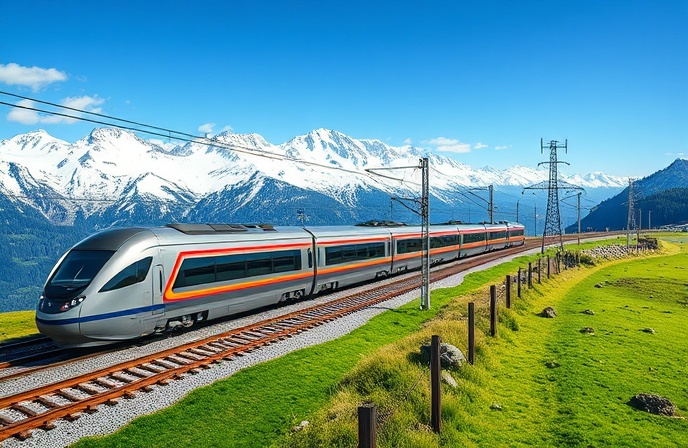
Ericsson and SBB have successfully integrated an IP Multimedia Subsystem (IMS) and Voice over LTE (VoLTE) system into Switzerland’s 3,100 km rail network, marking Europe’s first such deployment. This critical upgrade enhances onboard 4G connectivity for approximately 1,000 trains and ensures communication continuity ahead of Swisscom’s 3G service decommissioning.
| Key Entity | Critical Detail |
|---|---|
| Main Company | Ericsson, Schweizerische Bundesbahnen (SBB) |
| Core Action | Live integration of legacy GSM-R with IMS/VoLTE for railway communications. |
| Network Coverage | Switzerland’s 3,100 km rail network. |
| Timeline | Deployment began June 2023; nationwide system live April 2025; ~450 trains & 1,000 devices using VoLTE as of December 2025. |
| Key Date | December 5, 2025 |
Ericsson and SBB have achieved a significant milestone in railway communications with the live integration of an IP Multimedia Subsystem (IMS) and Voice over LTE (VoLTE) system, replacing legacy GSM-R infrastructure. This groundbreaking initiative, the first of its kind in Europe, now fully supports Switzerland’s extensive 3,100 km rail network, bolstering onboard 4G connectivity across approximately 1,000 trains. The successful deployment ensures seamless communication for SBB operations and prepares the network for future advancements.
Operational Transition and Technical Integration
The upgrade addresses the imminent decommissioning of Swisscom’s 3G service by providing a robust, modern communication solution. Previously, SBB relied on public 3G network roaming for voice communications in areas lacking GSM-R coverage. Faced with the discontinuation of 3G, SBB evaluated options for modernizing its communication systems and opted for an IMS and VoLTE-based architecture. This solution effectively bridges the gap between existing GSM-R functions and contemporary telephony systems, guaranteeing reliable voice and data services for railway operations.
Deployment Milestones and Network Readiness
The comprehensive deployment process, overseen by Ericsson, commenced with platform installation in June 2023. Early 2024 saw the successful completion of the first end-to-end VoLTE-to-GSM-R calls, demonstrating the system’s core functionality. Extensive field tests were conducted in January 2025 with pilot trains, receiving certification from Switzerland’s Federal Authority Office of Transport. The nationwide system went live ahead of schedule in April 2025, and as of December 2025, approximately 450 trains and 1,000 operational devices are actively utilizing VoLTE for critical communications.
Strategic Impact and Future-Proofing
The newly integrated IMS/VoLTE platform meticulously preserves essential safety-critical and rail-specific features, including EIRENE functional numbering, emergency stop calls, group calls, and onboard announcements. By leveraging 4G technology, SBB effectively mitigates disruptions associated with the phasing out of older 3G services. Furthermore, this modernization strategically positions the railway network for future innovations, such as the forthcoming Future Railway Mobile Communication System (FRMCS) which is based on 5G technology. SBB has proactively trained its teams to manage and support this significant migration, ensuring operational continuity and readiness for evolving technological landscapes.
Last June 2025, we published an article about Renfe’s cutting-edge Aranjuez maintenance hub. Click here to read – Future of Rail: Renfe’s Railway Technology Hub, Aranjuez: Essential Guide
An Ericsson representative commented on the project, stating, “Our work with SBB demonstrates our capability to deliver complex digital transformations under tight timelines. We look forward to setting benchmarks in railway communication innovation and supporting the transition to FRMCS in the coming years. While the full migration of train fleet communications and smartphone operations continues toward its December 2025 completion, the collaboration has paved the way for future enhancements. Valuable insights gained during this project will guide improvements in strategies for similar railway transformations globally.”
RELATED POSTS

January 7, 2015 11:49 am
Alstom has been awarded a 9-year maintenance contract by SJ1...

May 29, 2025 12:01 pm
Poland, May 2024 The Polish railway sector is experiencing a...

January 20, 2010 10:04 am
Iraq will invite bids shortly to build a $3bn passenger...

August 15, 2007 7:16 am
Leading technology companies, including designers of the Japanese bullet train,...
October 28, 2025 2:54 pm
Škoda Group's "Smart Depot" project revolutionizes **tram** maintenance using AI...

September 6, 2025 11:49 am
Rolls-Royce to supply 50 mtu engines for new Saudi Arabian...