
Eurostar & Deutsche Bahn Plan Direct London-Germany High-Speed Rail Link
Eurostar and Deutsche Bahn plan a direct high-speed rail link! The new service will connect London, Cologne, and Frankfurt, offering a sustainable alternative to air travel.
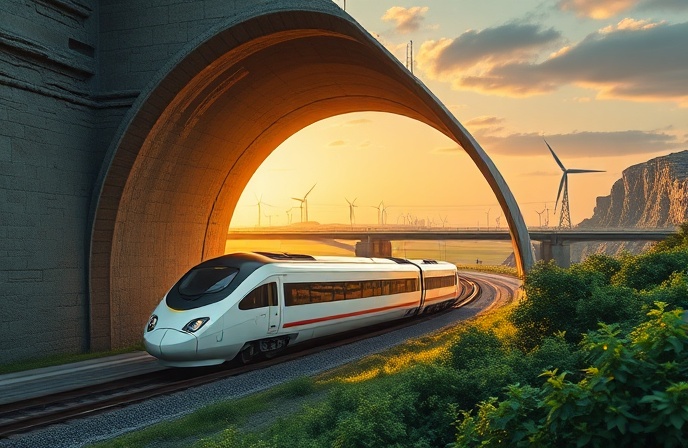
Eurostar and Deutsche Bahn have signed a Memorandum of Understanding, marking a significant advancement for a proposed direct high-speed rail link between the UK and Germany. The ambitious project, slated for the early 2030s, aims to connect London with Cologne and Frankfurt, offering a sustainable and convenient alternative to air travel and bolstering cross-border trade.
| Key Entity | Critical Detail |
|---|---|
| Operators | Eurostar & Deutsche Bahn (DB) |
| Core Action | Memorandum of Understanding signed for direct high-speed rail link |
| Key Destinations | London, Cologne, Frankfurt |
| Target Launch | Early 2030s |
| Estimated Travel Times | London to Cologne: ~4 hours London to Frankfurt: ~5 hours |
| Fleet | Eurostar’s future Celestia fleet |
Main Body:
The agreement between Eurostar and Deutsche Bahn (DB) represents a pivotal moment in the development of direct high-speed rail connectivity between the United Kingdom and Germany. This initiative, aiming for an early 2030s launch, seeks to establish the first non-stop high-speed rail service connecting London with major German cities, including Cologne and Frankfurt. The proposed route promises to deliver a substantially faster, more convenient, and environmentally responsible travel option compared to existing short-haul flights, with the potential to redefine European mobility and invigorate transatlantic trade relationships.
This landmark agreement follows closely on the heels of the inaugural UK-Germany joint working group meeting in Berlin. During this session, a consortium of authorities and rail industry experts from both nations meticulously examined the multifaceted technical, commercial, and regulatory hurdles that have historically impeded the establishment of direct rail services across the English Channel. Eurostar and DB are now committed to navigating these complexities with a clear objective: to enable direct journeys from London to Cologne in approximately four hours and to Frankfurt in just over five hours.
The operationalization of these new routes will leverage Eurostar’s forthcoming Celestia fleet. These advanced double-decker trains are engineered to significantly enhance passenger capacity by 20% while simultaneously achieving an impressive reduction in energy consumption of up to 50%. The introduction of such a direct service would be a historic achievement, forging a seamless city-center-to-city-center high-speed rail connection between two of Europe’s most economically robust nations for the first time.
Strategic Impact
The British government has underscored the profound economic benefits anticipated from this new rail link, including a substantial boost to tourism, foreign investment, and bilateral trade. This aligns directly with the administration’s broader agenda to enhance international mobility and connectivity. Prime Minister Keir Starmer hailed the project as a critical step towards a “better-connected Europe,” emphasizing the direct advantages for the UK populace through job creation and expanded access to European markets facilitated by simpler travel.
Operational and Environmental Considerations
From the German perspective, Michael Peterson, a member of the DB board responsible for long-distance transport, acknowledged the project’s “enormous potential” while also recognizing the inherent complexities of international rail operations, stressing the indispensable nature of operator collaboration. Crucially, this endeavor is fully aligned with the climate objectives of both the UK and Germany. A direct high-speed rail service would offer a compelling sustainable alternative to the significant volume of flights currently dominating busy routes, such as London-Frankfurt, thereby contributing materially to reducing aviation emissions.
This initiative builds upon a series of diplomatic engagements aimed at strengthening the UK’s rail connections with continental Europe. In July 2025, a bilateral treaty between the UK and Germany established a joint task force specifically mandated to dissect technical and regulatory impediments, encompassing border checks, safety standards, security protocols, and infrastructure interoperability. Furthermore, the project draws on the UK’s recent experience in securing a similar agreement with Switzerland, paving the way for a more comprehensive network of international rail services.
Analysis of current Channel Tunnel usage indicates substantial latent capacity, suggesting that new services can be introduced without necessitating immediate infrastructure expansion, a key factor bolstering the project’s viability. The ongoing work of the UK–Germany task force will involve a comprehensive assessment of several critical areas to facilitate the launch of direct services.
Last June 2025, we published an article about Renfe’s cutting-edge Aranjuez maintenance hub. Click here to read – Future of Rail: Renfe’s Railway Technology Hub, Aranjuez: Essential Guide
While a definitive timeline remains unconfirmed, authorities are optimistic about making “substantial progress” over the next decade, targeting an operational launch in the early 2030s. For Eurostar and DB, this collaboration transcends mere network expansion; it represents a strategic declaration that long-distance rail transport is poised to become the foundational element of European mobility, capable of overcoming geographical and political frontiers, including the formidable English Channel.
RELATED POSTS

January 2, 2017 2:21 pm
Here's a voiceover excerpt tailored for railway professionals:"TransLink's $877 million...
April 3, 2019 4:02 am
India's railway electrification gets a massive boost! A $750...

September 27, 2023 1:58 am
UIC Leaflet No: 829-5 – Chapter 8 – Technical Specifications...

February 18, 2025 1:34 am
The modernization of railway networks is a global imperative, driven...
June 21, 2018 5:01 am
Oslo's choosing CAF's Urbos trams for its €200m+ network upgrade!...
February 8, 2017 6:04 am
Alstom has been awarded a 17 million euro contract by...