
PKP & Gdańsk Port Expand Rail Access: Bolstering Baltic Freight Capacity
PKP and Gdańsk Port team up to significantly expand crucial rail access, boosting capacity for freight and improving infrastructure bottlenecks. Strategic railway investment.
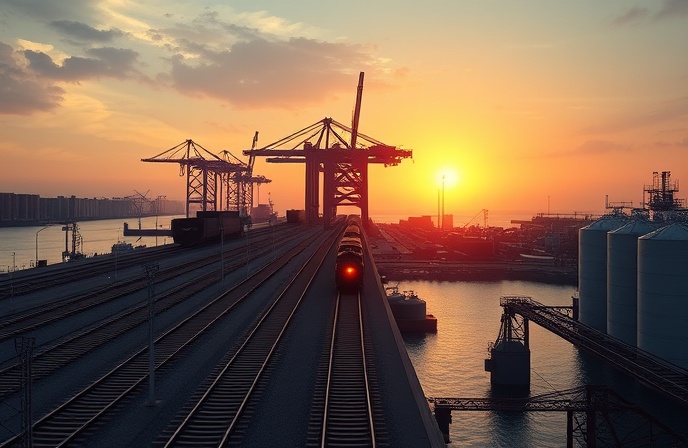
PKP Polish Railway Lines (PLK) and the Port of Gdańsk Authority have signed a pivotal agreement to significantly expand rail access to the port’s deep-water cargo terminals. This strategic collaboration aims to address critical infrastructure bottlenecks and enhance the logistical capabilities of one of the Baltic Sea’s most vital maritime gateways.
| Key Entity | Critical Detail |
|---|---|
| PKP Polish Railway Lines & Port of Gdańsk Authority | Agreement signed for expansion of rail access to deep-water terminals. |
| Strategic Importance | Enhances Poland’s energy security and economic development, strengthens Gdańsk’s Baltic position. |
| Investment Timeline | Feasibility study: 2026–2027; Design documentation: starting 2028; Investment works commencement: by 2034. |
| Current Challenge | Over 80% of cargo throughput relies on a single bridge for rail access. |
| Recent Investment (2019-2024) | Over PLN 3 billion (EUR 707.6 million) invested in rail access to Gdańsk and Gdynia ports. |
The agreement details the preparation of comprehensive documentation for both rail and road link expansions to the existing and future deep-water terminals situated in the Northern Port of Gdańsk. These terminals are the operational heart of the port, handling over 80% of its total cargo throughput. Facilities such as Naftoport, Gaspol, and the Northern Port itself are fundamental to Poland’s energy security. Concurrently, Baltic Hub’s role is crucial for the nation’s economic and logistical advancement, solidifying Gdańsk’s standing as a preeminent port on the Baltic Sea.
Strategic Impact and Operational Necessity
Dorota Pyć, President of the Port of Gdańsk, highlighted the pressing need for new rail infrastructure, stating, “The rapidly expanding Northern Port needs new rail infrastructure — additional tracks, sidings and greater capacity at the Northern Port station. The current network is already becoming a constraint on our development. Ports cannot grow independently of the rail network.” This sentiment underscores the strategic significance of the PLK and Port of Gdańsk Authority collaboration, which is designed to bolster the economy and national security by augmenting the logistical capacity of the Port of Gdańsk and the PLK-managed railway lines. In 2024 alone, the Port of Gdańsk managed an impressive 355,000 wagons, with all rail traffic to the deep-water section currently funnelling through a single bridge, a clear bottleneck.
Arkadiusz Marchewka, Secretary of State at the Ministry of Infrastructure, emphasized the critical role of seaports, stating, “The key role of seaports in the development of the Polish economy needs no explanation. To ensure they remain competitive, we must already plan further investments, including those aimed at improving capacity on railway lines.” The phased approach to this development will see a feasibility study completed between 2026 and 2027. This will be followed by the commencement of design documentation in 2028 (Stage II), paving the way for investment works related to the expansion of railway infrastructure by 2034 (Stage III). These works will encompass the modernisation and electrification of existing railway lines, alongside the construction of new sections to accommodate increased traffic volumes.
Last June 2025, we published an article about Renfe building a cutting-edge Aranjuez maintenance hub. Click here to read – Future of Rail: Renfe’s Railway Technology Hub, Aranjuez: Essential Guide
Industry Context
This development is a clear indicator of the strategic imperative for integrated, high-capacity rail-sea intermodal transport in European logistics. With a substantial investment of over PLN 3 billion (EUR 707.6 million) between 2019 and 2024, co-financed by the Connecting Europe Facility, already channeled into improving rail access to the ports of Gdańsk and Gdynia, this latest agreement signifies a sustained commitment to enhancing freight capacity. The ability to handle more, longer, and heavier freight trains directly to quays is crucial for maintaining the competitiveness of Polish ports and, by extension, the broader European supply chain in an increasingly demand-driven global market. CEOs of shipping lines, logistics providers, and cargo owners will view this as a positive development that reduces transit times and operational costs, while bolstering regional economic resilience.
RELATED POSTS

January 15, 2026 9:39 am
CN shatters grain movement records in 2025, moving over 32.7...
Union Pacific earned an 80% top Class I railroad intermodal...

October 28, 2018 10:03 pm
Bangkok's 20-year, $287M monorail maintenance contract with Bombardier proves the...

June 12, 2025 7:00 am
FRA unveils improved railway safety data website, boosting accessibility and...
August 24, 2016 7:19 am
Here's a voiceover-friendly excerpt:"The Canada Line, powered by SelTrac CBTC,...
September 6, 2025 1:01 am
Alstom awarded €450M contract for Bucharest-Giurgiu railway modernization, including ERTMS...