
Bengaluru Yellow Metro: Rail Innovations Transforming Indian Transport
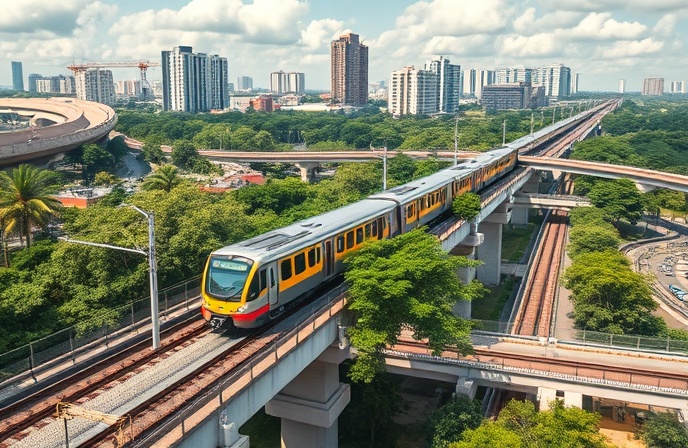
Bengaluru Yellow Metro Line opens, offering faster travel and improved connectivity in the city’s metro network.
“`html
Introduction
On August 10, 2025, Prime Minister Narendra Modi inaugurated the Bengaluru Yellow Metro Line, a 19-kilometer automated line connecting Rashtreeya Vidyalaya Road (RV Road) and Bommasandra, with passenger services commencing the following day.
Operational Launch
The Bengaluru Yellow Metro Line began passenger services on August 11, with trains running at 25-minute intervals. Full-scale operations, involving up to 15 trains, are anticipated by March 2026. The Prime Minister stated that the expansion would reduce travel times between Basavanagudi and Electronic City, improving the ease of living and working conditions for commuters.
Route and Infrastructure
The 19-kilometer Yellow Line features 16 elevated stations and is designed to alleviate congestion in Bengaluru, especially on routes to Electronics City. The line traverses significant residential, industrial, and educational areas, including Jayadeva Hospital, Silk Board, Electronic City, BTM Layout, and Bommasandra. It connects with the Green Line at RV Road and will intersect the future Pink Line at Jayadeva Hospital and the Blue Line at Central Silk Board, facilitating multimodal integration.
Technology and Performance
The driverless metro line incorporates CBTC signaling, AI-powered track monitoring, and advanced safety systems. This technology reduces travel time from over 90 minutes to 35 minutes end-to-end. On its first day, the line served approximately 83,000 passengers. The projected daily ridership is between 800,000 and 1.25 million commuters.
Last June 2025, we covered a cool story about a hydrogen-powered locomotive. Click here to read – The Future of Rail: Sierra Northern’s Hydrogen Locomotive Revolution
Further Developments
During the same ceremony, Prime Minister Modi also launched Phase 3 of the Bengaluru Metro – the Orange Line – which will span 44 km and include 31 elevated stations. Additionally, he flagged off three Vande Bharat Express trains from KSR Railway Station in Bengaluru. These services include routes from Bengaluru to Belagavi, Amritsar to Shri Mata Vaishno Devi Katra, and Nagpur (Ajni) to Pune. India’s metro network now covers over 1,000 km across 24 cities.
Conclusion
The Bengaluru Yellow Metro Line’s launch enhances urban mobility by improving connectivity to IT hubs, residential zones, and commercial areas. The operational metro network in Bengaluru now exceeds 96 kilometers. Passenger feedback has identified issues with train frequency, station signage, and seating availability.
Company Summary
KSR Railway Station: Located in Bengaluru, it served as the departure point for the Vande Bharat Express trains.
Technology
CBTC: The Yellow Line incorporates CBTC signalling, AI-powered track monitoring, and advanced safety systems.
“`
RELATED POSTS

Union Pacific earned an 80% top Class I railroad intermodal...

March 6, 2026 12:10 pm
Consortium Announces Digital Services Platform for UK Rail Sector A...
March 5, 2026 7:57 pm
Banedanmark launched battery train operations on Denmark's 67 km Skjern–Holstebro...

March 4, 2026 10:12 am
Amtrak and Siemens deploy 8 Airo trains for the U.S....

March 5, 2026 4:23 am
Renfe suspends Spain rail services on Madrid-Andalusia corridor until February...
March 6, 2026 4:07 pm
Digital Subscription Market Analysis Q1 2026 Analytics firm Antenna confirmed...